Showing posts with label World War I. Show all posts

Friday, August 11, 2017

From Ennistymon to the Cariboo Wagon Trail ~ Part One


Leopold George Duncan Galwey-Foley (1888-1984) was the third child born to our grandfather's legal guardians, Ida Burke Browne (1868-1940) and her husband, Edmund Augustine Galwey-Foley (1852-1922).

Our second cousin 1x removed, stories of Leo's life always fascinated my father.

A rebel, an adventurer, a hunter, a miner, an engineer, a hermit, a jeweler, an Army deserter, an Army hero, a curmudgeon- all describe our cousin Leo at various stages of his life.

In the 1830s, our great great grandparents, Elizabeth Fleury (1798-1870) and Patrick Edward Reilly (1799-1872) leased Moher Lodge near Liscannor from Colonel Francis Macnamara of Ennistymon House. [1]


It was here - and on its 72 surrounding acres - where their five children were born and raised:

Eliza (Bessie, 1833-1881);
Hannah Marie (Nannie, 1835-1911);
Edward (1836-1890);
Mary (1837-1894);
Henry Patrick (1838-1894).

Of those five children, only the eldest and the youngest were to marry and have children of their own.

In 1860, Bessie Reilly married Edmund Burke Browne at the Ennistymon Chapel. [2]


The newlyweds set up house at the estate owned by the Burke Browne family in Kilmilhil. It was called Castlepark House. [2]

In all, the couple had seven surviving daughters, of whom Ida Anna was the fifth.

Born on September 22, 1868, Ida and her sisters attended school in Ennis at the Convent of the Sisters of Mercy where her future cousin-in-law, Mary Milward,  had also been a student.[3]


Throughout her life, Ida was well known as an accomplished equestrienne.

In 1922, her cousin, William Patrick Gavin of Kildysart House, published his reminiscences of equestrian life in the hunting fields of county Clare.

Titled: True Sporting Verse, in the third of his thirteen verses in praise of Ida ........"a lovely young woman", Gavin writes:

"No matter what kind of horse she got on,
Trained or untrained ''twas the same,
For a minute she got up and sat on their backs,
They became gentle and tame."


When she was only 16 years old, Ida married the accountant in the National Bank on Parliament Street in Ennistymon - Edmund Augustine Galwey-Foley (1852-1922) who was 16 years her senior.


Over the years while living near Ennistymon, Ida seems to have developed a warm and close friendship with her cousin's wife, Mary Milward Reilly - who was our great grandmother. Mary named Ida to be the legal guardian of her only son, Patrick Henry Reilly AKA: Gillie - and the two women shared a love of riding and fox hunting.


Ida and Edmund Galwey-Foley had six children - two daughters (Gladys & Hilda) and four sons (Edmund, Leo, Tom & Percy) - all of whom were born and grew up in Lahinch near Gillie's home. 

Gillie and the boys remained lifelong friends ....... even in America.

The third child of Edmund and Ida - Leopold George Duncan (1888-1984) - is the focus of this post.


In about 1900, the Galwey-Foley family moved from Ennistymon to Carrickmacross when Edmund was promoted to manage that branch of the Bank of Ireland in county Monaghan. 

The family lived at the Bank House on Main Street in Carrickmacross until Edmund retired to Dublin where he died in 1922.


When Gillie's mother passed away in 1904, he moved up to Carrickmacross to live with his legal guardians and cousins.[4]

I am sure that Gillie regarded these cousins as his brothers (and sisters) because, as mentioned, he remained close to all of them throughout his life.

As you will learn, Leo led a bold and unconventional life - a life which had always fascinated my father.

A rebel, an adventurer, a hunter, a miner, an engineer, a hermit, a jeweler, an Army deserter, an Army hero, a curmudgeon- all describe our cousin Leo at various stages of his life.

Leo - like the entire Galwey-Foley family - loved the sporting life of the Gentry.

 Anything to do with animals, hunting, shooting, riding, dogs was their passion.

Once sport were involved, it mattered not whether the location was Kildysart, Leopardstown, Cheltenham or New Jersey -the Foleys were ready!

Leo once told of a noteworthy hunt for rabbits when he was a boy near Ennistymon. 

One night, a Lancer-man from the local garrison enticed the son of the Macnamara game-keeper into a night of drinking in an Ennistymon pub.


While the Lancer-man was getting the son drunk, Leo and the lads had "capital sport" on the Macnamara estate using ferrets to hunt rabbits! (Wonder if Gillie were among the "lads".)

As Leo told it - of all the Banks in Ireland - the National Bank had a fierce reputation for frequently "interfering" or prying into the family lives of its managers.

Sons of Bank Officials were meant to socialize with sons of Military Officers - NOT with the sons of ordinary soldiers.

I am sure, his father's employers were NOT amused upon hearing of this 'hunting expedition'.

In 1906, when he was 19 years old, Leo left Ireland to emigrate to Halifax, Nova Scotia where he worked for a jeweler.

A few years later, we find Leo working for the Canadian Pacific Railway (CPR) during the construction of the Connaught Railway Tunnel.


In 1913, the CPR had awarded to the firm of Foley Brothers, Welch and Stewart a contract valued at $15,000,000 to $20,000,000 to construct a six mile double-track tunnel through the Rogers Pass in the Selkirk Mountains of British Columbia. It was considered the longest railway tunnel in North America.

At the Western Approach to the Tunnel, the engineers were faced with diverting the River Illecillewaet!


This required shifting a 56 foot glacial moraine off the hard rock bottom.

To accomplish this feat, the contractors employed a 100 ton Bucyrus steam shovel which they had mounted onto a platform of railroad ties.

Leo was there - often hitching a ride to and from the site on the footplate of a light locomotive. 

After work, he'd often drop off for a "dip" at the nearby Canyon Hot Springs.


A few miles West of Leo's Connaught Tunnel, an historic marker reads: 

"A nebulous dream was a reality: an iron ribbon crossed Canada from sea to sea. Often following the footsteps of early explorers, nearly three thousand miles of steel pushed across vast prairies, cleft lofty mountain passes, twisted through canyons and bridged a thousand streams."


Stories of the Canadian Pacific Railway and the Cariboo Gold Rush of the 1860s must have been part of Leo's general education as a boy in Ireland.

In 1881, shortly after his Grandmother Bessie Reilly had died and 25 years before Leo had emigrated, Edmund & Ida had bought shares in The Electric Light and Power Generator Company. 

In that year, the Ottawa Electric Light Co. had built a small power plant to feed the 325 arc lamps that illuminated several streets in the city. Thomas Edison had also perfected the light bulb that same year. 

In 1883, electricity illuminated the Canadian Houses of Parliament and streetcars made their appearance in Ottawa.

This investment became an important source of financial support for the Galwey-Foley family and in the educational formation of their six teenagers.

Leo had been in Canada for eight years when World War I broke out.
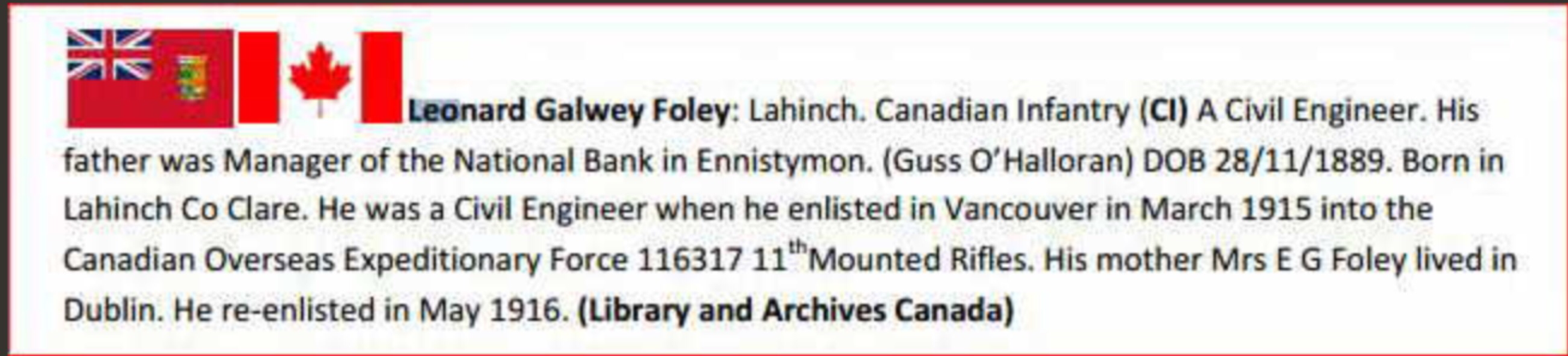


A keen hunter and horseman, in Vancouver, he enlisted into the 11th Canadian Overseas Expeditionary Force Mounted Rifles while in March 1915.


While his unit was heading for the Canadian port for embarkation to Europe, Leo would already be aware that poison gas had been used in the trenches during the Second Battle of Ypres.

Advance information circulated among his Canadian unit that The Mounted Rifles were scheduled to be dismantled and used in Trench Warfare as foot soldiers.


July 1, 1915, marked the beginning of the Battle of the Somme - an infamous battle of trench warfare which lasted until November 13th.

About this time, SOMEWHERE in Canada, Leo Foley suddenly disappeared....... By all appearances, a deserter.........

However, on July 7, 1916, our Leo re-surfaces in Ottawa enlisting (with an Irish pal) into the 52nd Battery of the Canadian Field Artillery.


Leo had re-invented himself - he was now Daniel Joseph Burke.......born 1891.

"Daniel" was assigned to be the Driver of the Horse-Drawn Artillery.


Daniel Joseph Burke.

Clues to his choice of names may possibly be derived from his mother's families.

O'Grady was one.

The name Daniel was given to generations of first-born O'Grady sons.

Joseph?

One of his brothers (our Uncle Tom Foley) was baptized Thomas Joseph. Tom had already emigrated to the United States and was serving in the United States Army.

Burke?

Leo's mother was a member of the Burke-Browne family.

But, no one knows Leo's motivation for sure.

As Driver Daniel Joseph Burke, Leo Galway Foley had his first encounter with enemy forces while he was somewhere in France. 

UNARMED, his outfit had been transported to the Western Front.

Their task was to "disarm retreating Italians fleeing before the advancing Germans".  

Using their boots, their fists and hand-to-hand combat, the Canadian Field Artillerymen wrested their guns from the Italians.

According to Leo/Daniel - 

They then, fired those same guns on "Germans coming through .....shoulder to shoulder. No ranged was required." 

He continued: "The Artillery used 'open sights' blowing holes in the advancing Germans, using those 18 pounder field guns on two-wheeled carts."


MEANWHILE......

Behind the Front Lines, Canadian Military Intelligence Units were hot on the trail of "two Irishmen missing from the Canadian Mounted Rifles".

At that time, British Military Authorities may have been concerned about gun-running to Ireland and the smuggling of other components.

Driver Burke's Sergeant was coming under increasing pressure from his superiors. He finally insisted on "leveling" with his men in order to get to the truth.

They made a deal: 

"I'll look after you; you look after me. Whenever the Military Police come up on your tail, I'll send you along my section of the Front Lines to keep my positions fully manned.......maybe holding you there in reserve until they decide to move their search elsewhere."

In France, Leo was gassed four times.

Always as Daniel Joseph Burke, he spent THREE tours on the Western Front - exceeding the regulation quota.

Leo/Daniel was demobilized "without scars" but........ as his Irish cousins recalled - he was TRULY 'punch drunk' also known as "blighty".  

During a week or so of "blighty" leave from the Western Front, Leo arranged to meet his sister Gladys who was working in Dublin as a clerk at the National Bank.

His younger sister, Hilda, was also working at the Bank of Ireland.

Their brother, Percy, had joined the Royal Irish Rifles and later became Consul in Boston for The Irish Free State.

On August 11, 1919 in France, Daniel J Burke received his Honourable Discharge "by reason of demobilization" and was awarded the War Service Badge Class "A" No. 176611.[5]


Before returning to Canada, he spent some time in Ireland.

Leo was very fond of his maternal aunt, Louisa Quinn, neé Burke Browne 
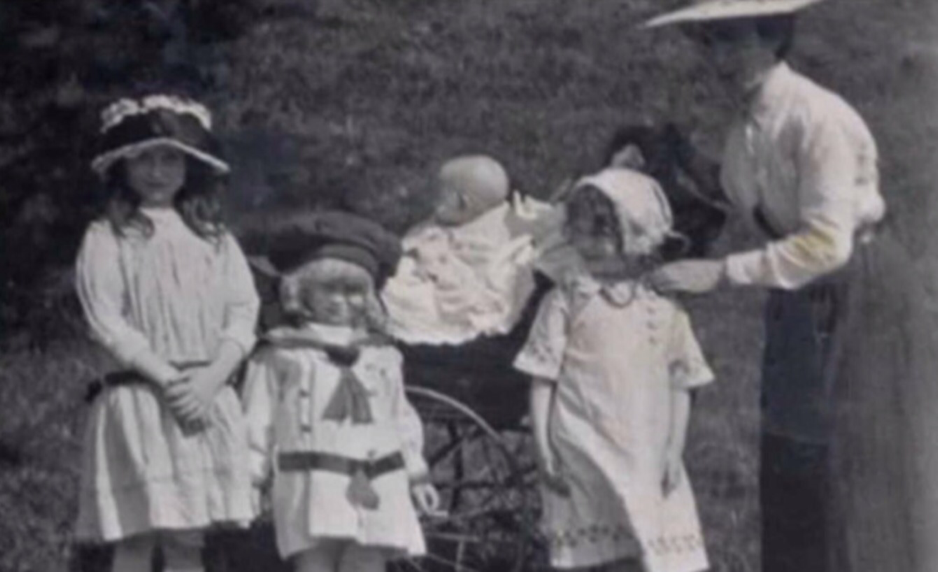


He often recalled meeting her daughter, Venerable Edel Quinn.[6]


Here, we will conclude Part One of "From Ennistymon to the Cariboo Trail".

Please be sure to tune in next week for Part Two of Leo Foley's adventurous life as a Gold Miner in the Carboo Mountains of British Columbia.


Most of the details of Leo's life were taken from an article written by Father Edmund O'Keefe, SJ. 

"From Ennistymon to the Cariboo Wagon Trail" was published in the Ennistymon Parish Magazine in 1994.


[1] For more information about our Moher Lodge history, see -  


[2] For more information about Bessie Reilly Burke Browne, see - 


[3] For more information about the education of the female members of our family in 19th century Ireland, see -  


[4] For more information about Gillie's relationship with his Galwey-Foley cousins, see - 


[5] 


[6] For more information about our cousin, Venerable Edel Quinn, see -  


EPILOGUE 

History gives a nation its bearing on what it is and how its people are affected by what has happened in the past. 

Its kings and queens, its wars - with victories and defeats - these all mold a nation’s culture into the way it views itself in the present. 

In the same way, a family history presents how a family has survived and come to terms with the great social and cultural experiences of the ages.

We hope these stories will give each member of our family a foundation and, in some small way, explain how we came to be what we are today.

Hopefully, through these vignettes, our future generations will gain a knowledge of the energy and dynamism, the loves and hates, the errors and mistakes, the victories and failures, the struggles and successes that make us what we are.

Our family history presents a fascinating read - and, hopefully, some lessons to be learned in the process.




Wednesday, June 14, 2017

"...In New York, you can forget ....The Irish been coming here for years..."


When the  RMS Lusitania was launched in 1906, she was the largest, fastest, most luxurious, most spacious and most comfortable ship afloat and the first ship able to cross the Atlantic Ocean in under five days.

When she arrived in New York harbor at the end of the first leg of her maiden voyage in 1907, this is the greeting she received:

".....In New York,  hundreds of thousands of people gathered on the bank of the River Hudson from Battery Park to pier 56. 

"All New York's police had been called out to control the crowd. 

"100 horse drawn cabs had been queuing from the start of the day ready to take away passengers."


In New York Harbor


With elevators, en-suite facilities, electric lighting and heat, she was heralded for the extraordinary design of her interiors and for the stress the staff were taught to place on emulating high hotel standards onboard - emphasizing both service and comfort.

With 550 First Class (or Saloon) Cabins, 500 Second Class Cabins and 1,300 Third Class (or Steerage) Cabins, the passenger accommodations aboard the Lusitania were unquestionably the most spacious and beautiful of their time.


When our grandfather, Gillie, lost his 49 year old widowed mother in 1904, he found himself relocated to Carrickmacross in County Monahan to live with his legal guardians:  Ida and Edmund Galwey-Foley.

Ida was his first cousin and Gillie had grown up among her four sons and two daughters in County Clare.


Ida Burke-Browne Galwey-Foley (1868-1940)

Edmund was a bank manager for the National Bank of Ireland which meant that the family was required to move to a different town whenever he was transferred.


He'd been at the Carrickmacross branch since 1896 (and would stay there until he retired in 1914.


Edmund Galwey-Foley (1852-1922)


At the time, it was customary for the Bank to provide housing for its managers and families.

These Bank Houses were usually very fashionable and big enough to accomodate large Irish families along with the requisite 2 or 3 live-in servants.

In Carrickmacross, the Galwey-Foleys lived at 31 Main Street.

Living Quarters are above the Bank


Although the Bank moved to this building after Edmund had retired, the manager's family lived above.

According to the Irish Census in 1901, there were 11 members of the Galwey-Foley household living together in the Bank House.

This included two live-in servants.


Louisa Burke-Browne, Ida's baby sister, would be the mother of Venerable Edel Quinn and is Tom McCormick's grandmother.

You may read more about our cousin: Vernable Edel Quinn in this post published last May.


As we might imagine, the Bank House on Carrickmacross’ Main Street must have been a very large home to accommodate so many people.

For Gillie, the move to Carickmacross immediately after losing his mother must have been a difficult transition.

He and his mother had already moved from Ennistymon in the country to the capital city of Dublin about 4 years earlier.

In 1901, they were living as lodgers at 52, Upper Leeson Street in the very posh Rathgar section of Dublin.

52, Upper Leeson Street


When his mother passed away in August, no one even thought to notify Gillie's school, Terenure College, that he would not be returning for classes.

For more detail about their time in Dublin, please check out this post from last June -


He was 18 years old when he arrived in Carrickmacross.

Did he work? 

Where did he attend college?

We do not yet have the answers to these questions.

At any rate, we do know that he and his cousin, Tom Galwey-Foley, remained friends throughout their lives and, according to the US 1910 Census, Tom emigrated to America in 1906.

In Carrickmacross, perhaps they discussed the prospect of emigrating.

I had heard from my father that, one day, Ida had assembled all five boys together and TOLD them what profession she had expected each boy to pursue.

For Percy: Diplomacy

For Tom: Banking

For Edmund: Banking

For Gillie: Law

It was at that moment when Tom & Gillie decided: "I don't think so!"

Whatever the case, sometime after Tom had left home, Gillie made the decision in 1908 to leave Ireland and to emigrate to America.

But, he did not sail to New York in steerage, like most Irish immigrants.

Gillie purchased a Second Class ticket aboard the RSM Lusitania leaving from Liverpool on December 8, 1908.

His ticket cost about £28.

Gillie would have had to catch the Lusitania in Liverpool.

Here is that Ship's Manifest:


As you can see, Gillie has listed his occupation as "student" .... which makes me wonder if he were still attending school before he left Ireland. Or perhaps, he’d recently graduated?

He had left Terenure College in 1904 when his mother had died....... he did not graduate from that school and a "college" in Ireland is not a university but a secondary school. He was only 18 in 1904.

Percy Galwey-Foley (Uncle Tom Foley’s brother) went to Blackrock in Dublin but I'd never heard that Gillie had gone there, too. And I doubt very much that he would have ever returned to Dublin.


He was 22 years old when he left Ireland ..... but we still have no idea how he was spending his time while in Carrickmacrosss....

Second Class passengers on ocean liners usually came from the Professional classes: attorneys, teachers, doctors, etc.

On the Lusitania, Second Class accomodations were far superior to even First Class on other vessels.

Staterooms were furnished with white enamel and mahogany furniture which was upholstered in "moquette" (a thick pile fabric).

A Second Class Cabin featured two sets of bunks. 

Two wash basins with running water were situated  between them.

There might also be a small sofa, a chair, an armoire and space to stow a small trunk.

Second Class Cabin aboard RSM Lusitania


In those days, people traveled with far more baggage than we do today. But on a ship, space was always limited so all luggage was customarily tagged before embarking indicating "wanted" or "not wanted". "Not wanted" would then be sent to the hold until arrival at its destination.

Bed curtains on ships of this period were for far more than simply decorative purposes. 

They served to offer some privacy in the cabin. 


They helped keep the heat in and the chill out, because, outside of the public rooms, central heating was rare.

The weather in the North Atlantic is notoriously unpleasant most of the year. Passengers embarking on a transatlantic voyage were well advised to pack warm clothes and long underwear, even in summer.

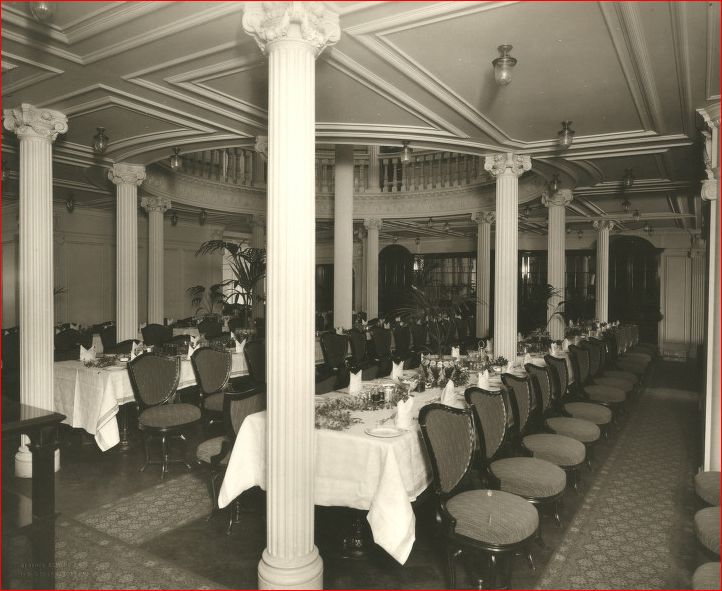
The Second Class dining room echoed the layout of First Class but was more simplistic in its styling.

Second Class Dining Room RSM Lusitania


Decorative plaster was used to cover support braces and that gave the room a pleasant, pillared look.

An open well over the center of the room made it feel much larger than it actually was.

Although not as lavish as the meals served in First Class, here is an example of a Lusitania lunch served to those in Second Class.

Diners began their meal with Puree Soubise.

The fish course was Salmon Trout with Dutch Sauce. 
For the main course, diners could choose from  Steak and Kidney Pudding, Braised Veal with Lemon Sauce, Roast Turkey with Bread Sauce, Ox Tongue with Carrots.
The choice of sides included boiled rice, puree of turnips and boiled potatoes. 
Cold boiled ham was also on offer. 
Dessert followed and diners could select from Damson Tart,  ‘Gelee Cunard’, Macaroon Toten, Saxon Pudding and ice cream. 
Cheese was then served and tea and coffee were available throughout and after the meal.

With full stomachs, the Second Class passenger might retire to the Second Class Lounge which was located at the stern of the ship.


The Lounge was the main gathering place for Second Class passengers

Measuring 40' x 42', it was furnished with mahogany settees, chairs and tables set on a rose carpet.


The center of the Lounge was positioned at the topmost section of the Second Cabin staircase and was crowned with a skylight.

There  was a Smoking Room which was reserved for Second Class men. 


It was decorated with mahogany panelling, blue tinted sliding windows, white plasterwork ceilings and a dome.


On one wall was a mosaic of a river scene in Brittany.


So, Gillie had purchased his Second Class ticket leaving from Liverpool to New York City.


Although there were other routes to Liverpool, the majority of emigrants traveled via Dublin's Kingstown port (now renamed Dun Laoghaire). 


He probably took the train from Carickmacross to Dublin.


From Dublin, mail, livestock and cargo ships offered deck passage across the Irish Sea, a notoriously fickle stretch of water, to Liverpool.

By 1896, the shortest sea crossing took under 3 hours. In foul weather, the journey could be twice as long.

Very few who arrived in Liverpool could go directly to a waiting ship. But, maybe sailing on the Lusitania made these arrangements easier.

Otherwise, passengers were met on arrival by representatives of the ship and taken to boarding houses and hostels that were either affiliated or owned by the steamship lines. 

Passengers and their luggage were collected from their accommodation on the day of departure (or the evening before, depending on tides) and taken to the quay where they either boarded their ship or were carried by boat to their ship waiting in the estuary. 


For Gillie sailing on the Lusitania, the journey to Ellis Island was an opulent and luxurious experience. But, considering the upheaval of his life,  I will bet he must have been filled with anxiety during the voyage.


It could have been worse, of course....

On December 13, 1908, as the ship entered New York harbor, and the Statue of Liberty came into view, Gillie, along with his fellow passengers,  probably felt less trepidation and more simple excitement. 

For most, the journey to Ellis Island still had a few hours to run.

The steamship would dock at either the Hudson or East River piers to disembark its First and Second Class passengers.

The better-off simply passed through Customs at the pier and were free to go.


Above is Gillie's Debarkation Manifest Document.

First off ~ Leaving Ireland, he listed his occupation as "student". Perhaps he was still attending school before he left. His guardians seemed to have stressed education to their children ~ even their daughters ~ so they might have insisted that he continue.

Now, however, he claims to be a "grocer".

But notice that the passenger listed directly above him is also a "grocer".

Maybe, the two men formed some bond en voyage and Gillie decided that being a grocer was a more adult or serious occupation than being a mere student.

Don't know .....

Then ~ he lists his last address in Ireland as: "Miss Reilly, 18 Hume Street, Dublin".

Hmmmmmm

At the time, his cousin, Percy Galwey-Foley, had just graduated from Blackrock College in Dublin and had gotten a job with the Diplomatic Service.


He was living as a boarder at that address with his fellow diplomat clerks.

I like to think that while in Dublin to catch his boat to Liverpool, Gillie might have stopped to see Percy and to visit his mother's grave at Glasnevin Cemetery to say good bye.


Then, he might have spent the night with Percy at 18 Hume Street.

What were Gillie's plans once he got off the ship in New York?

He claims to be going to Brooklyn....

Wonder where he did go ..... how long did it take to find a place to live on his own...... to find a job.... how did this rich, protected, naive, lonely country kid manage during those first years in the busiest, largest city in the New World? 

He never much talked about it ..... so we do not really know .....


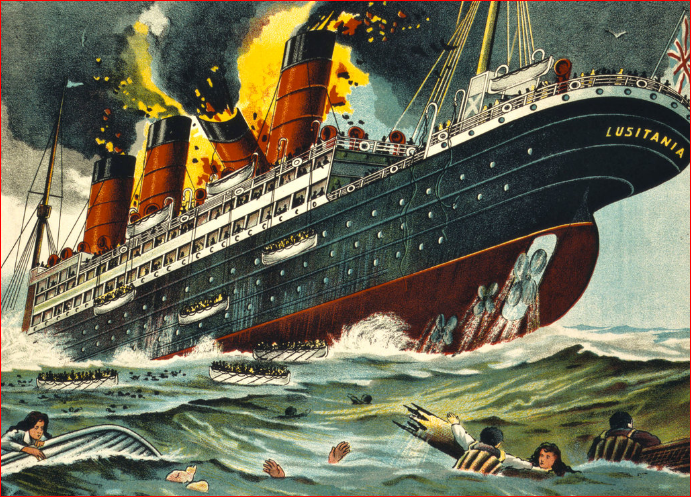
THE LAST VOYAGE OF RSM LUSITANIA


Despite a published warning from the German authorities that appeared in U.S. newspapers the morning of her departure, the Lusitania carried a healthy complement of American passengers when she departed New York for Liverpool on May 1, 1915, 


By this time, several British merchant ships had already been sunk by German subs, but the famous liner's speed still seemed to be her best guarantee of safety. 

However, certainly her captain and crew should have been on high alert. 

As the Lusitania neared the end of her crossing, a German U-boat sank three British ships in the waters south of Ireland.

This was the sea lane through which she was about to sail.

The Captain received repeated warnings that U-boats were active on his intended course. 

Yet on May 7, as the Lusitania entered the most dangerous part of her passage, Captain William Turner actually slowed down, apparently worried by patchy fog.


When U-20, under the command of Kapitänleutnant Walther Schwieger, found a huge four-stacker in its sights just south of Queenstown, Ireland,  she was able to kill the Lusitania with a single torpedo which penetrated her hull, just below the waterline. 

The initial explosion set off a violent secondary blast. 

The ship sank in 18 minutes, with a loss of 195 of the 1,959 on board, including 123 Americans. 


Captain Turner was washed clear of the bridge as the ship sank, and survived after spending more than three hours in the water.

The loss of the Lusitania provoked great outrage in the United States and helped create the climate of public opinion that would later allow America to join the war.

It also marked the end of any delusions that the "civilized" manners of 19th century warfare could survive into the 20th. 


Since I first learned that the RSM Lusitania was the ocean liner which brought our grandfather to America, this ship has become very special to me.

I remain surprised that no one in our family had ever mentioned that the Lusitania was a part of our history.

I wonder if Grandpa had even told them!


EPILOGUE 

History gives a nation its bearing on what it is and how its people are affected by what has happened in the past. 

Its kings and queens, its wars - with victories and defeats - these all mold a nation’s culture into the way it views itself in the present. 

In the same way, a family history presents how a family has survived and come to terms with the great social and cultural experiences of the ages.

We hope these stories will give each member of our family a foundation and, in some small way, explain how we came to be what we are today.

Hopefully, through these vignettes, our future generations will gain a knowledge of the energy and dynamism, the loves and hates, the errors and mistakes, the victories and failures, the struggles and successes that make us what we are.

Our family history presents a fascinating read - and, hopefully, some lessons to be learned in the process.